



Bowing Wall Repair in Springfield: When Clay Soil Pushes Back
Springfield sits on glacial till and windblown loess silt over clay, and that clay drains slowly. Spring rain and snowmelt build groundwater against basement walls, and the freeze-thaw cycles of our cold winters work the same walls from the outside. If you own a 1900s brick bungalow in Enos Park or Ridgely, or a 1950s ranch in Southern View with a block basement wall that has started to lean, Bowing Wall Repair in Springfield is the work that stops the movement before it becomes a structural problem. We install carbon fiber straps, steel I-beams, and wall anchors matched to the severity of the bow and the soil pushing on it. Book a free basement inspection and we will tell you plainly whether you have a structural issue or a water issue, because the two are often confused.
Why Bowing Walls Are Common in Springfield's Older Basement Stock
Most bowing walls we see in Springfield are in stone, brick, or early block basement walls built between 1900 and 1960. Those walls were never designed for the hydrostatic pressure that saturated clay soil puts on them, and decades of wet springs and freeze-thaw cycles have taken a toll. The tell is usually a horizontal crack at mid-wall, a wall that leans inward at the top, or a bulge you can see when you sight down the wall from the stairs.
- Horizontal cracks in a block or brick wall signal pressure from outside, not settling.
- A wall that leans inward at the top is usually a sign of clay pushing against the footing.
- Doors and windows that stick on one side of the basement often mean the wall has moved.
- Efflorescence and damp patches on the wall point to water coming through, which accelerates the movement.
- Stair-step cracks in block joints are a warning that the wall is losing its ability to carry load.
If you see any of these, get the wall looked at before the next wet season, because movement rarely reverses on its own.
Key info: A homeowner in Chatham called us about a 1958 block wall that had bowed about an inch and a half over the winter. The cause was saturated clay against the outside face after a wet spring, not a failing footing. Carbon fiber straps stabilized it without excavation, and we addressed the water with an interior perimeter drain.
Before you hire anyone, check the contractor's standing with the Illinois Department of Financial and Professional Regulation and confirm what your local building department requires for structural foundation work.
How We Diagnose and Repair a Bowing Wall in Springfield
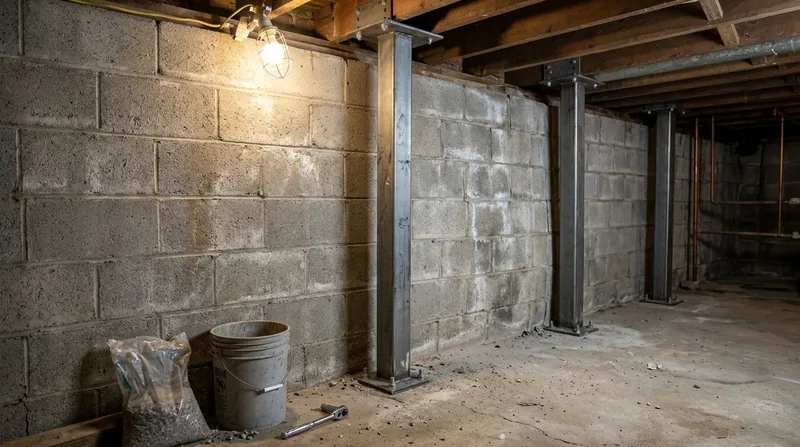
We start by measuring the wall, not guessing at it. A plumb line and a level tell us how far the wall has moved and in which direction, and we check the footing and the soil conditions around the foundation. From there we match the repair to the severity: a wall that has moved less than two inches usually responds to carbon fiber straps, while a wall that has moved further or is carrying heavy load may need steel I-beams or wall anchors.
- We inspect the wall, the footing, and the drainage around the foundation to find what is driving the movement.
- We measure the bow and record the crack pattern so we have a baseline to compare against later.
- We recommend carbon fiber straps, steel I-beams, or wall anchors based on the severity and the soil.
- We install the repair, then address the water that caused the pressure so the wall is not fighting the same load again.
- We hand you a written summary of what we found and what we installed.
The repair stabilizes the wall, but the water still has to go somewhere, which is why we treat the drainage as part of the same job.
Key info: On a 1920s foursquare near downtown Springfield, the basement wall had bowed and the floor was damp after every heavy rain. We installed carbon fiber straps on the wall and tied the repair to an interior drain tile system so the clay pressure and the water were handled together.
Repair Methods We Use and When Each One Fits
Not every bowing wall needs the same fix. The right method depends on how far the wall has moved, what the wall is made of, and how much load it carries. Here is how we match the approach to the problem.
| Approach | Description | Best for |
|---|---|---|
| Carbon fiber straps | Straps bonded to the wall and anchored to the floor and joist above to stop further inward movement. | Block or poured walls with moderate bowing and no major footing failure. |
| Steel I-beams | Vertical steel beams set against the wall and anchored to the floor to carry the load. | Walls with heavier movement or where the wall itself is losing strength. |
| Wall anchors | Anchors set in the soil outside pull the wall back toward plumb over time. | Walls that have moved several inches and can be straightened. |
| Drainage correction | Interior perimeter drain and sump to relieve the hydrostatic pressure behind the wall. | Any bowing wall where water is the driver, which is most of them in Springfield. |
In most Springfield basements, the repair is a combination: stabilize the wall, then relieve the water so it does not push again.
Bowing Wall Repair Cost in Springfield: What to Expect
Bowing wall repair is priced by the linear foot of wall and by the method, so there is no single number that fits every house. As a starting point, simple carbon fiber strap work begins at $600 for a small section, and a full wall stabilization with drainage correction runs higher. The main cost drivers are how far the wall has moved, how many straps or beams the wall needs, and whether the water problem behind the wall has to be corrected at the same time.
Access matters too. A basement that is finished or packed with storage slows the work, and a wall that needs anchors set in the yard outside adds excavation. We give you the range in writing before we start, and we tell you when a simpler fix is enough and when the wall needs the full stabilization. Get two or three estimates and compare the scope line by line, not just the bottom number.
For a fuller breakdown of how we price below-grade work, see our pricing overview.
Finding a Bowing Wall Repair Contractor Near Me in Springfield
When you search for a bowing wall repair contractor near me in Springfield, the list is long and not every name on it does structural wall work. Ask each contractor whether they are licensed and insured, whether they carry general liability and workers' compensation, and whether they will put the scope in writing. Ask for references from jobs in Springfield or the surrounding towns and call them.
Permits are commonly required for structural foundation repair in this area, and the rules vary by jurisdiction, so confirm the requirement with your local building department before work starts. A contractor who hesitates to pull a permit for structural work is a contractor to pass on. Get at least two or three estimates and compare what is actually included.
If you want to talk through what you are seeing, contact us and we will set up a free inspection at your Springfield home.
Bowing Wall Repair in Springfield: Pricing Guide
| Service | Price | Details |
|---|---|---|
| Carbon fiber strap repair (small section) | Starting at $600 | Includes wall inspection, strap layout, and bonding on a short run of wall |
| Full wall carbon fiber stabilization | Starting at $1,800 | Covers a full wall run with multiple straps anchored to floor and joist |
| Steel I-beam or wall anchor system | On estimate | Heavier movement or outside excavation means the scope has to be measured on site |
| Drainage correction with wall repair | On estimate | Interior perimeter drain and sump priced with the stabilization after we see the water source |
| Travel | Included | In Springfield and surrounding areas, no separate call-out or mileage fee |
| Estimate | Free | Response within 24h at (217) 960-8508, no obligation to book |
Indicative pricing, the exact cost depends on square footage, finish, and site access. Free personalized estimate within 24h at (217) 960-8508.


