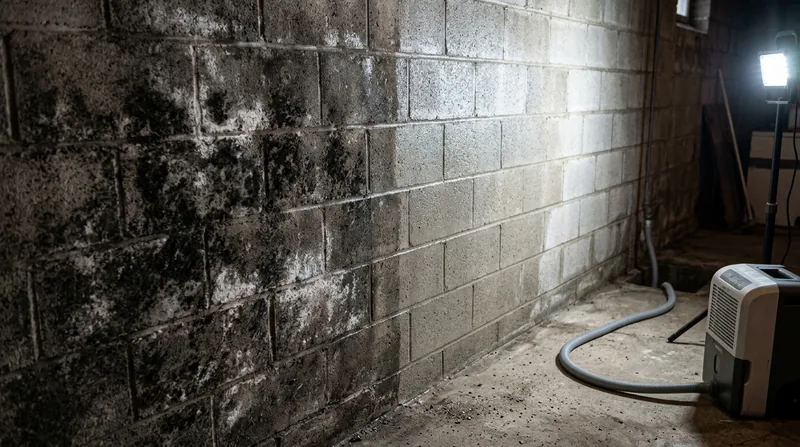




Springfield sits on glacial till and windblown loess silt over clay, and that clay drains slowly. When spring rain and snowmelt hit the older brick and frame bungalows in Enos Park and Ridgely, groundwater stacks up against stone and early block basement walls and pushes through. Basement Mold Remediation in Springfield is not a scrubbing job, it is a moisture job: we find why the wall is wet, fix that, then treat the mold that grew on the damp block, joists and drywall. We handle below-grade moisture only, and we tell you plainly when a crack seal is enough and when hydrostatic pressure means an interior drain tile system is the real answer. Start with a free basement inspection so the remediation plan matches the actual water source.
Why Mold Grows in Springfield Basements and What Actually Stops It
Mold needs moisture and organic material, and Springfield basements supply both. The 1900s to 1940s foursquares and Colonial Revivals near downtown have full basements of stone, brick or early block that wick groundwater all spring. The 1920s to 1960s brick ranches in Southern View and across the south and east sides have partly finished basements where drywall and framing sit right against a damp wall. West and north side subdivisions from the 1970s to 2000s have poured full basements, and a failed sump pump or a short discharge line turns a dry floor into a wet one overnight.
- We trace the moisture source first, whether it is wall seepage, a failed footing drain, a clogged weeping tile or a sump pump that quit during a storm.
- We set up containment and remove affected drywall, insulation and framing that cannot be dried and cleaned.
- We treat structural surfaces and then correct the water path so the mold does not return next spring.
- We check the musty smell at the end, because a basement that still smells damp is a basement that is still wet.
Remediation without the moisture fix is a repeat job, and we do not sell repeat jobs.
Key info: A homeowner in Riverton had mold climbing the lower block of a 1950s ranch every April. The wall was dry in August. The culprit was a collapsed clay footing drain that only backed up under spring hydrostatic pressure, not a leak in the block itself.
The Illinois Department of Public Health publishes guidance on moisture and mold in homes that is worth reading before you hire anyone: Illinois Department of Public Health mold guidance.
How We Run Basement Mold Remediation in Springfield, Step by Step
Every job starts with the water, not the bleach. We walk the basement, read the efflorescence line on the wall, test the sump basin and check grading and downspout extensions outside. Then we build a scope that separates mold work from drainage work, so you see what each part costs and why.
- We inspect the basement and foundation and identify the moisture path, including hydrostatic pressure at the wall base.
- We contain the work area with plastic and negative air so spores do not spread into the finished part of the basement.
- We remove porous materials that cannot be saved and HEPA vacuum and treat the structural surfaces that stay.
- We correct the water source with the right method, whether that is epoxy injection at a crack, an interior perimeter drain, or a new sump pump with a check valve.
- We dry the space, verify with moisture readings, and confirm the musty smell is gone before we close out.
The order matters: drainage and drying first, treatment second, verification last.
Key info: In a 1920s foursquare off Ridgely, the mold was on the furring strips behind finished paneling. We pulled the paneling, treated the brick, and installed an interior drain tile system tied to a new sump basin. The wall has stayed dry through two spring thaws.
Remediation and Moisture Control Methods We Use
There is no single method for every basement. A hairline crack that weeps after rain is a different problem from a stone wall that stays damp all spring. This table shows how we match the approach to the condition we find.
| Approach | Description | Best for |
|---|---|---|
| Surface treatment and HEPA cleaning | Containment, removal of unsalvageable material, HEPA vacuuming and treatment of structural surfaces. | Light surface mold on block or joists with a known, fixable water source. |
| Crack injection plus wall sealing | Epoxy or polyurethane injection at the crack, then a waterproof sealer or parging on the interior face. | Poured walls with a defined crack that seeps after rain. |
| Interior perimeter drain and sump | Interior drain tile at the footing, new sump basin, pump and discharge line. | Hydrostatic pressure pushing water up through the floor and wall base all spring. |
| Vapor barrier and dehumidification | Heavy vapor barrier on the floor and walls, plus controlled dehumidification for humid summers. | Basements that stay damp from summer humidity rather than a single leak. |
| Exterior waterproofing and membrane | Excavation, waterproof membrane and dimple board on the outside face of the wall. | Walls that are wet through the full thickness and cannot be corrected from inside. |
We recommend the least invasive method that actually solves the water problem, and we say so when that is not the biggest job on the list.
Basement Mold Remediation Cost in Springfield: What to Expect
Most basement mold remediation projects in Springfield start from $1,500, and that figure covers a defined area with containment, removal of affected material, surface treatment and a moisture check. The number moves with the size of the affected area, how much finished material has to come out, and whether the water source needs drainage work before treatment can hold. A single damp wall in a Sherman ranch is a smaller scope than a fully finished Southern View basement with mold behind paneling and a failed sump pump.
You should also expect the drainage fix to be priced separately and honestly. If the real problem is hydrostatic pressure at the footing, treatment alone will not last a season. We lay out both parts on the estimate so you can decide what to do now and what can wait. Two or three written estimates is the right way to compare scope, not just the bottom line. Our full pricing overview shows how the ranges break down.
Basement Mold Remediation Near Me: How to Choose a Contractor Near Springfield
Ask for the license and insurance certificate before anyone walks into your basement, and confirm the policy covers mold remediation work, not just general labor. Get the scope in writing, including what gets removed, what gets treated and what gets verified at the end. Call two past customers in Springfield or Chatham and ask whether the basement stayed dry the following spring.
Permits are commonly required for structural foundation repair and for work that alters drainage or the sanitary connection of a sump discharge, and thresholds vary by jurisdiction. Always confirm with the City of Springfield building department before work starts, and check any HOA rules for exterior discharge or grading changes. A contractor who hesitates on that question is telling you something. Reach us through the contact page and we will walk you through what your address needs.
Basement Mold Remediation in Springfield: Pricing Guide
| Service | Price | Details |
|---|---|---|
| Surface mold treatment, single area | Starting at $1,500 | Containment, HEPA cleaning and treatment of one affected wall or floor area, with moisture check |
| Finished basement remediation | Starting at $2,800 | Removal of affected drywall and insulation, treatment of framing and block, drying and verification |
| Remediation plus drainage correction | On estimate | Mold work paired with crack injection, interior drain tile or sump replacement after on-site inspection |
| Musty smell diagnostic | Included | Moisture readings and source tracing included with every remediation estimate, no separate fee |
| Travel | Included | In Springfield and surrounding areas, no separate call-out or mileage fee |
| Estimate | Free | Response within 24h at (217) 960-8508, no obligation to book |
Indicative pricing, the exact cost depends on square footage, finish, and site access. Free personalized estimate within 24h at (217) 960-8508.


